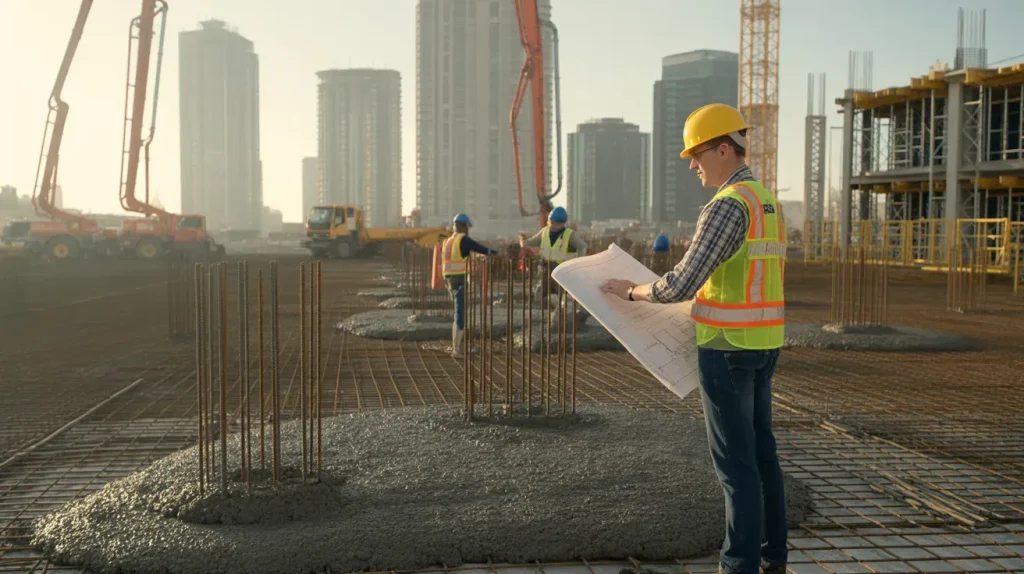
Concrete looks simple from the outside. But the moment you step into the world of industrial commercial concrete projects, that simplicity disappears. The loads are heavier, the tolerances are tighter, and the margin for error is almost zero. A mistake on a residential driveway is inconvenient. A mistake on an industrial floor slab can shut down an entire operation.
What Sets Industrial Commercial Concrete Projects Apart from the Rest
Industrial builds operate under conditions that most structures never face. Think about constant forklift traffic, chemical spills, temperature cycling, and point loads from heavy equipment. All of that demands concrete that is engineered, not just poured.
Compare that to residential concrete construction projects, which typically involve driveways, patios, and home foundations. The mix designs, thickness requirements, and inspection standards are in a completely different league. Residential work is important, but industrial work operates at a higher level of technical demand.
Furthermore, the scale of large commercial concrete projects means that even small oversights compound quickly. A slightly off subgrade across 80,000 square feet of warehouse floor can lead to major slab failure within just a few years.
Common Project Types and Their Core Requirements
Not every commercial concrete project looks the same. However, they all share a need for precision, proper planning, and experienced crews. Here is a breakdown of the most common types:
| Project Type | Key Technical Requirement | Most Common Issue |
| Warehouse and Distribution Floors | Flatness (FF/FL values), load capacity | Curling, joint deterioration |
| Tilt-Up Construction | Panel strength, lifting inserts | Misalignment during crane erection |
| Structural Foundations | PSI rating, rebar cover depth | Poor soil compaction, settlement |
| Parking Structures | Post-tensioning, waterproofing | Corrosion from de-icing salts |
| Industrial Flatwork | Vapor barriers, surface hardeners | Chemical attack, surface dusting |
Each of these project types requires a different strategy. There is no universal approach that works across all of them.
The Demands of Structural Commercial Concrete Projects
Structural commercial concrete projects involve load-bearing systems that hold entire buildings together. We are talking about shear walls, post-tensioned slabs, grade beams, and reinforced columns. These elements must perform reliably for decades, not just pass a first inspection.
That is why structural concrete work always follows engineer-of-record drawings and undergoes third-party special inspections. There is no room for field improvisation when a column has to support five stories of floor load above it.
“Structural concrete is not just about compressive strength today. It is about maintaining that performance thirty years from now.”
How Modern Concrete Construction Projects Are Changing the Industry
| Innovation | Description | Key Benefits |
| Maturity Sensors | Embedded sensors that monitor real-time curing temperatures and strength development. | Eliminates guesswork, enables faster loading, and tighter project schedules. |
| Self-Consolidating Concrete (SCC) | High-flow concrete mix that spreads into complex forms without mechanical vibration. | Reduces labor costs, improves quality in congested rebar areas, and delivers smoother finishes. |
| Fiber-Reinforced Mixes | Concrete enhanced with synthetic or steel fibers. | Significantly reduces cracking, increases durability, and extends the service life of slabs. |
| Low-Carbon Cement Alternatives | Use of fly ash, slag, and other supplementary materials instead of traditional Portland cement. | Lowers carbon footprint while maintaining required strength and performance. |
| Laser Screed Technology | Advanced laser-guided machines for leveling large concrete pours. | Achieves superior flatness tolerances essential for modern warehouse and industrial floors. |
Urban Builds and Concrete Contractor Scheduling Solutions
Working in dense urban environments adds another layer of complexity. Staging areas are limited. Traffic must be managed. Noise ordinances restrict work hours. Deliveries must be timed precisely because concrete in a truck has a short window before it becomes unusable.
Concrete contractor scheduling solutions have become an essential part of managing large city builds. From phased pour planning to permit coordination with municipal inspectors, urban industrial projects require as much management expertise as they do concrete expertise.
Additionally, underground utilities, proximity to occupied buildings, and vibration control all need to be factored in before the first truck arrives on site.
Choosing the Right Contractor for Large Commercial Concrete Projects
The right contractor makes a measurable difference. Before committing to any team, ask these questions:
- Do they have documented experience on commercial concrete projects of a similar size and complexity?
- Can they provide references from past industrial or structural builds?
- Do they perform on-site concrete testing such as slump tests, air content checks, and cylinder breaks?
- Are their crews ACI-certified or equivalent?
- Do they carry the right insurance, licensing, and bonding for your project type?
- Can they coordinate phased pours, concrete pumping, and nighttime work if needed?
A qualified contractor does not just show up and pour. They help you avoid problems before they start.
Frequently Asked Questions
What PSI is required for industrial and commercial concrete projects?
Most industrial floors require a minimum of 4,000 PSI. High-load environments often call for 5,000 PSI or higher, combined with reinforcement and surface hardeners for added durability.
How long does a large industrial concrete building typically take?
It depends on the scope and phasing. A single warehouse floor slab can take two to four weeks. Multi-phase structural builds can run several months. Proper scheduling reduces downtime significantly.
What is the biggest cause of slab failure in industrial settings?
Poor subgrade preparation is the leading cause. Even the best concrete mix will fail if the base beneath it is not properly compacted, graded, and tested before the pour.
Does Illice Concrete handle both structural and flatwork on the same job?
Yes. Illice Concrete has experience across the full scope of concrete work, from structural foundations to finished industrial flatwork, all under one contractor for simpler coordination.
Conclusion
In the 21st century, concrete is the foundation of modern industry. As the saying goes, not everyone can handle a stallion; just like that, handling concrete is not everyone’s cup of tea. Industrial commercial concrete projects require careful engineering, quality materials, experienced crews, and a team that takes ownership from the first plan review to the final pour. Cutting corners at any stage leads to expensive problems down the road. If you are planning a facility, warehouse, or large commercial structure and you want it built right the first time, the team at Illice Concrete is ready to help.
